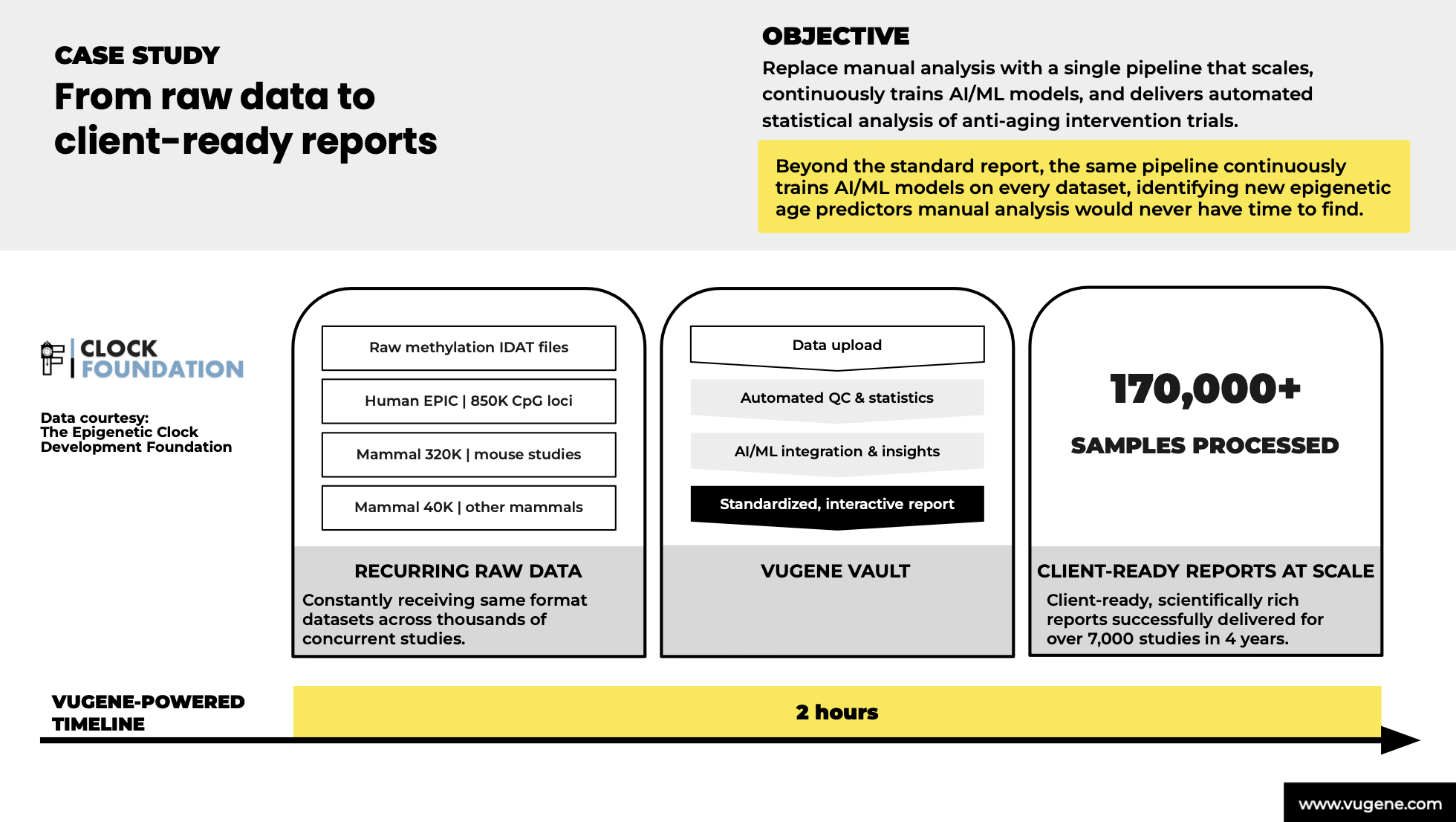
Organizations that generate omics data as a service, such as contract research organizations (CROs), build their core competency around data generation: study design, sample preparation, sequencing or mass spectrometry, and delivery of raw and processed data files. The Epigenetic Clock Development Foundation, a non-profit UCLA spin-out, operates on a similar service model for epigenetic aging research. It makes epigenetic aging clocks, including PhenoAge, GrimAge, and multi-species clocks spanning diverse mammalian systems, accessible for preclinical and clinical longevity studies, and develops new ones. VUGENE was chosen to build the analysis layer behind that service.
The Challenge
CROs deliver high-quality data at scale, but clients increasingly expect more than the data itself. They want to know what it means for their programs. Building that interpretation capacity in-house usually requires specialist analysts for every data type and study design, and the team has to grow as volume grows.
The Epigenetic Clock Development Foundation needed interpretation infrastructure that could process diverse epigenetic aging study designs rapidly and reproducibly in parallel, while also supporting the development of new epigenetic age predictors.
How VUGENE Approached It
STEP 1: Automated epigenetic data pipeline
VUGENE built an automated pipeline to ensure consistent and reproducible processing of epigenetic data across different aging study designs.
STEP 2: Simultaneous ML/AI and statistical testing
Machine learning and statistical testing run together within the same pipeline, so each dataset is assessed through both approaches.
STEP 3: Parallel processing at production scale
The infrastructure processes multiple independent datasets in parallel, so interpretation capacity scales with study volume without additional analytical headcount.
STEP 4: Supporting next-generation clock development
Beyond interpreting individual studies, the pipeline produces a growing dataset on which new clock architectures can be trained.
STEP 5: Shifting scientific focus to higher-order questions
With VUGENE’s support, the Epigenetic Clock Development Foundation’s clients can focus on the bigger scientific questions: which interventions influence biological age, in which populations, and through which epigenetic mechanisms. Meanwhile, the Clock Foundation’s team can explore opportunities to develop new epigenetic clock architectures using the growing dataset.
Download PDF here
Why It Matters
By embedding VUGENE’s interpretation layer directly into a data-generation service, every deliverable provides a biological decision rather than just a dataset. For clients, this reduces re-analysis cycles, accelerates biomarker triage, and enables more confident prioritization of interventions.
Powered by VUGENE, the Clock Foundation has successfully processed over 170,000 samples in four years, empowering its scientists to focus on interventions that modify and determine biological age without scaling analytical headcount.
Request a demo here
Cover image credits: eda / Adobe Stock