
Rare disease research often runs into the same wall: small, heterogeneous patient cohorts where conventional analysis struggles to separate real biological signals from noise. A research team at Corewell Health, facing exactly this challenge, reached out to VUGENE. They were investigating a rare disease and working to define the molecular consequences of the disease-causing mutation while tracking patient response to a targeted treatment over time.
The Challenge
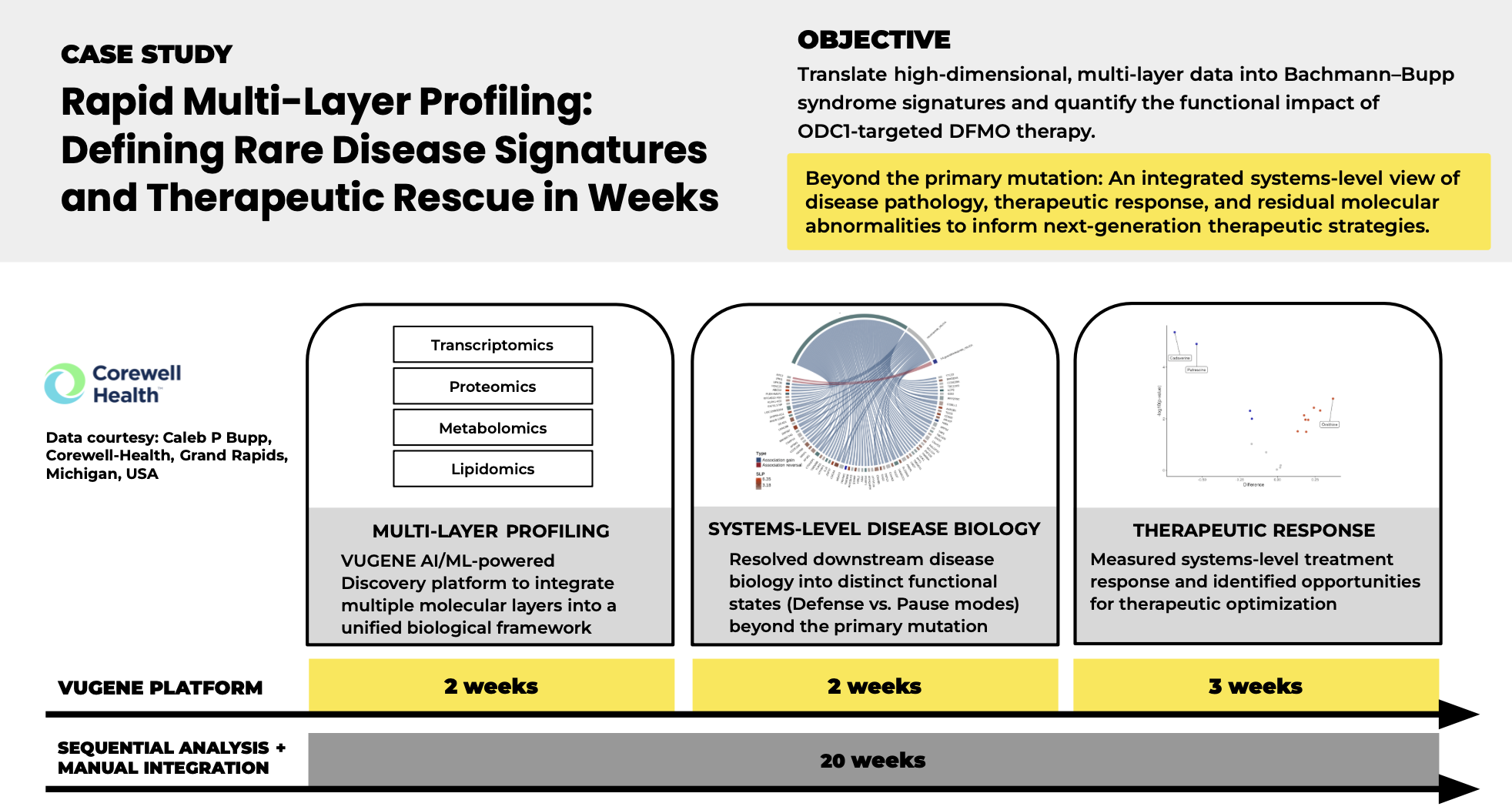
The multi-layer dataset spanned transcriptomics, proteomics, metabolomics, and lipidomics from the same patients – generating more than 30,000 molecular features across four omics layers. Under a conventional workflow, each omics layer would be analyzed independently over several months, requiring individual specialist expertise at every stage.
In small cohorts, analyzing individual molecular features in isolation allows biological signals to be obscured by noise. This masks coordinated pathway dynamics, leaves the principal drivers of disease unresolved, and limits the detection of subtle treatment-associated molecular effects critical for therapeutic optimization.
How VUGENE Approached It
Step 1: Standardized, modality-specific processing
Each omics layer was processed using standardized, automated pipelines tailored to its specific modality. Quality control, signal normalization, and missing-value imputation were applied to eliminate batch effects and technical artifacts.
Step 2: Modeling disease- and treatment-associated effects
To account for inter-patient variability and repeated post-dose measurements within small cohort constraints, linear modeling frameworks were applied to isolate true disease- and treatment-associated effects over time.
Step 3: Pathway-level aggregation
Recognizing that individual feature signals in small, noisy cohorts face severe statistical power limits, VUGENE overcame this feature noise by aggregating multi-layer data at the functional biological level using Gene Set Enrichment Analysis (GSEA) and structured knowledge frameworks. This pathway-resolved approach transformed 30,000+ raw features into a clear cellular roadmap, mapping downstream pathology, quantifying temporal treatment rescue, and identifying residual molecular abnormalities to guide future therapeutic complementation.
Step 4: Characterizing systems-level disease biology
Crucially, while the causative genetic defect was known, the systems-level molecular consequences of the mutation remained uncharacterized. VUGENE mapped these core biological drivers for the first time, resolving pathology into distinct operational states, such as active cellular “Defense Modes” (immune/stress alerts) versus “Pause Modes” (growth/energy suppression).
Step 5: Evaluating therapeutic response
Building on this systemic baseline, VUGENE evaluated the molecular impact of intervention. Although Bachmann-Bupp syndrome was an established ODC1 gain-of-function disorder and DFMO was the targeted therapeutic rationale, VUGENE provided the first comprehensive, multi-layer molecular assessment of the treatment response.
Why It Matters
The Corewell Health collaboration translated 30,000+ molecular features across biological layers into an actionable cellular roadmap – moving from data to decision in weeks for a study that traditionally requires months of sequential analysis. Beyond speed, the pathway-resolved approach surfaced a systems-level view of disease biology and treatment response that individual, feature-by-feature analysis would have missed – along with residual molecular abnormalities that can help guide future therapeutic optimization.
Read more about Dr. Caleb Bupp and his research in the article: “An old drug held the key to treating a rare pediatric disease. Scientists are teaming up to advance its use to treat more patients.”
Cover image credits: Milan / Adobe Stock