Client
Dr. Ulrike Menkes, Wayne State University
Background
Insulin phenolic preservatives (IPPs) are added to all commercial insulin formulations to ensure insulin stability, extend shelf life, and provide bactericidal properties. However, since they are not native to the body, researchers questioned whether they trigger an immune response when delivered into the skin over an extended period, a reality of daily life for diabetes patients.
Dr. Ulrike Menkes of Wayne State University and her research colleagues aimed to investigate this immune response within the context of extending the lifespan of insulin infusion devices.
Standard insulin infusion sets are approved for use for 3 days, or up to 7 days with extended-wear designs. However, many insulin pump users choose to replace them earlier due to infusion set failures, which can hinder the adoption of insulin pump therapy and automated insulin delivery systems.
Dr. Ulrike Menkes and her team were concerned that prolonged dosing at a single site via a catheter could increase infusion-site inflammation, potentially leading to scar tissue formation over time and making the site unavailable for future diabetes management devices.
“When insulin is delivered through a device, it can cause minor tissue damage. This attracts immune cells called neutrophils, which are among the body’s first responders. When neutrophils undergo a specialized form of cell death, they release a web-like structure made of their own DNA and proteins, called neutrophil extracellular traps, or NETs,” explained Dr. Ulrike Menkes.
Images are worth a thousand words, when you look at these NETs under a microscope after staining, they resemble actual nets intended to trap and slow down external intruders. While this is a defense mechanism of the immune response, excessive NET formation can lead to tissue damage and chronic inflammation.
Until recently, Dr. Ulrike Menkes and her team had only studied NETs in the context of swine tissue. The natural next step was to assess cell death and NET formation in the presence of IPPs in humans. Since proteins are the active agents of our cells, Dr. Ulrike Menkes’ team started with proteomics. More importantly, as protein activation is achieved by adding phosphate groups, Dr. Ulrike Menkes selected the specific omics approach they needed: phosphoproteomics.
Dr. Ulrike Menkes and her team generated proteomic data using standard immunological assays to study the effects on human neutrophils of IPP-containing insulin, filtered (IPP-free) insulin, and a solution of just the filtered IPP.
The challenge they faced was then analyzing the data. While Wayne State has in-house bioinformaticians, their time is split across the entire university.
“Getting to work with them can be very difficult from a time standpoint. So, having a third-party partner is vital. VUGENE was well-recommended by another collaborator,” explained Dr. Ulrike Menkes.
Solutions
VUGENE performed:
- Differential protein phosphorylation analysis
- Kinase-substrate enrichment analysis
- Signalome and NETosis-focused analyses
Using the data produced by Dr. Ulrike Menkes’ team, VUGENE ran a full phosphoproteomic analysis using its standardized analysis tools combined with custom expertise. They investigated the differential abundance of phosphorylation and proteins with statistical analysis (linear modeling). Additionally, they performed kinase substrate enrichment analysis based on phosphosite-specific kinase substrate databases, signalome analysis (using protein-protein interactions), NETosis-targeted sub-analysis, and statistical data integration of different experiments – processes beyond the capabilities of Dr. Ulrike Menkes’ team alone.
“That’s the beauty of working with a partner like VUGENE – you don’t even need to know or understand bioinformatics. You just need to explain the big picture and the context. Then VUGENE can compare the data and generate the analysis. We go from there,” explained Dr. Ulrike Menkes.
VUGENE identified strong immune-response signaling driven by IPPs, including:
- Increased activation of inflammatory pathways
- Elevated Rho GTPase signaling
- Patterns consistent with heightened tissue stress
The findings following VUGENE’s analysis speak for themselves. The proteins that were most differentially activated (phosphorylated) belong to many different signaling pathways (indicated by the heatmap, Figure 1.
Figure 1. Heatmap showing the top 50 different protein phosphorylation sites between filtered insulin (Insulin without IPP) and standard insulin (Insulin with IPP).
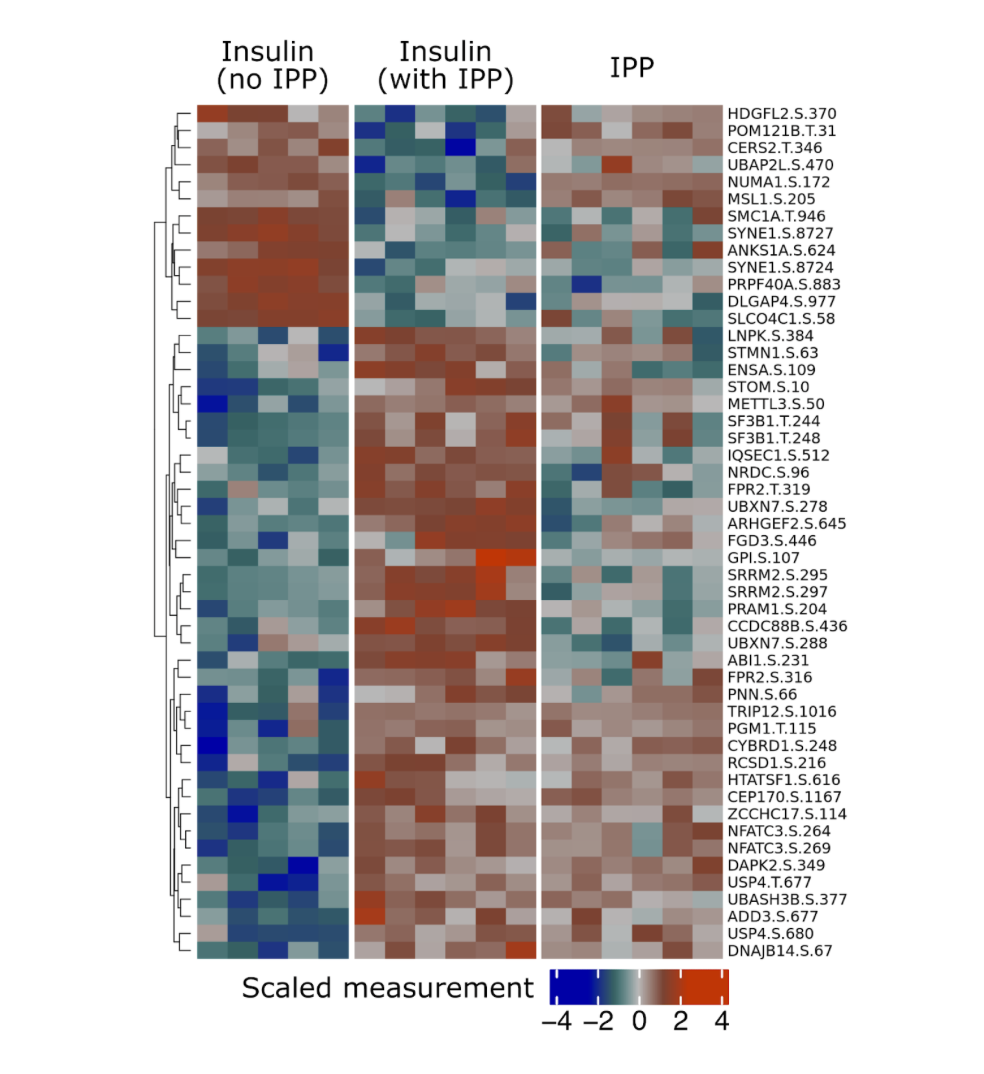
This indicates that the presence of IPPs induces a variety of immune-response-related reactions. IPP-affected cells demonstrate downregulation of the mitotic cell cycle and higher levels of cell signaling, especially by Rho GTPases. These are significant modulators of behaviors that, when dysregulated, are associated with cancers and fibrosis.
Cover image credits: adrian_ilie825 / Adobe Stock